
Quick summary
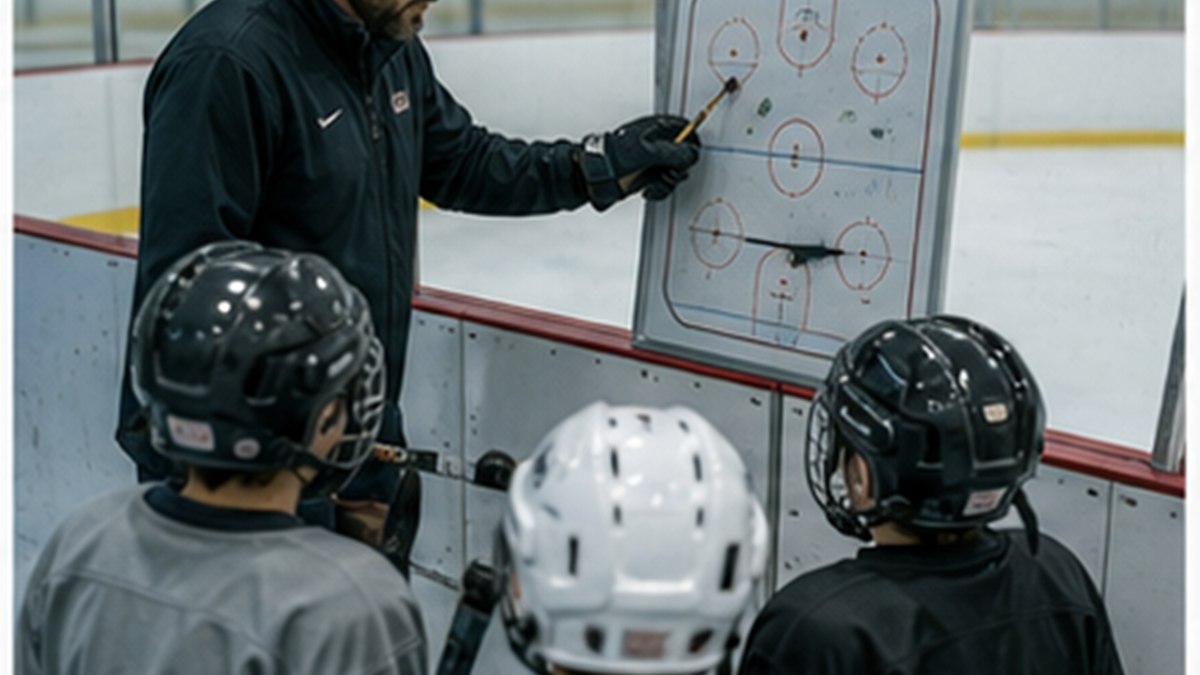
- Puck support means spreading into open passing lanes near the puck carrier instead of crowding around the puck.
- The give-and-go is the simplest support pattern to teach first, since it only involves two players and a short pass.
- Small-area games build support habits faster than whistle-heavy drills because the tight space forces quick decisions.
Why Young Players Chase the Puck Instead of Supporting It
Definition
Puck support: Positioning teammates in open passing lanes near the puck carrier, rather than around them, so the carrier always has a nearby option instead of skating into pressure alone.
Youth hockey at its earliest levels often looks like a swarm around the puck, with every skater on the ice drawn toward it. That instinct isn't wrong exactly, it's just untrained, since young players naturally want to be near the action.
Puck support redirects that instinct into something useful. Instead of standing still or crowding the puck carrier, supporting teammates spread into passing lanes where they can actually receive a pass and keep the play moving.
What Puck Support Looks Like on Ice
A supporting player stays roughly a stick length to a few strides away from the puck carrier, angled so a pass doesn't have to travel through an opponent. That spacing gives the carrier a safe outlet without closing off the ice the carrier is trying to use.
- Stay off the puck carrier's direct line, not directly behind or in front.
- Angle toward open ice, not toward the boards.
- Keep moving instead of standing still waiting for a pass.
Why It Matters More Than Individual Skill
A single skilled puck carrier can only beat so many defenders alone before losing the puck. A team that consistently supports the puck carrier creates more scoring chances than one relying on individual rushes, even at a younger age level.
Teaching the Give-and-Go as a First Support Option
The give-and-go is usually the simplest support pattern to teach because it only involves two players and a short pass. A player passes the puck, then immediately skates to open space to receive it back, rather than passing and stopping.
Coaches can introduce this without any defenders first, so players can focus purely on the timing of the pass and the movement after it. Once the pattern feels automatic, adding a single defender forces players to find the give-and-go under light pressure.
- Player A passes to Player B and immediately skates toward open ice.
- Player B receives the puck and looks up before making a decision.
- Player B returns the pass to Player A in open space.
- Both players keep skating, not standing, through the entire sequence.
Drills That Build Support Positioning Under Pressure
Small-area games are one of the most effective ways to build support habits, since the tight space forces players to find outlets quickly or lose the puck. A three-on-two or two-on-one in a small zone rewards players who move to open passing lanes.
Coaches should resist the urge to stop play every time a player chases the puck out of position. Letting the game continue and pointing out the missed support option afterward usually sticks better than a whistle every few seconds.
| Drill | Focus | When to Use |
|---|---|---|
| 2-on-0 give-and-go | Passing timing and off-puck movement | Introducing the concept |
| 2-on-1 to a small net | Support under a single defender | After give-and-go feels automatic |
| 3-on-2 small-area game | Finding open lanes under real pressure | Once basic support habits are forming |
Coaching Language That Reinforces Support Habits
Telling players to spread out is vague and tends to fade once the puck starts moving. More specific language, like calling out a player's name and the space they should fill, gives players something to act on in the moment.
Praise the pass that wasn't made just as often as the one that was, since a player who skated into a good support position but didn't get the puck still made the right read. Reinforcing the decision, not just the outcome, is what makes the habit stick.
A team that supports the puck carrier doesn't need to be the most skilled team on the ice. It just needs to give the puck carrier somewhere to go.
Related SportX1 resources
Frequently asked questions
At what age should coaches start teaching puck support?
Most coaches can start introducing basic give-and-go concepts around age 8 or 9, once players are comfortable skating and stickhandling at the same time.
How do I stop players from all chasing the puck at once?
Small-area games and specific position callouts work better than telling players to spread out, since the tight space naturally forces support decisions.
Should support positioning be taught before or after individual puck skills?
They can develop together, but many coaches introduce basic puckhandling first so players have enough control to execute a support pass under light pressure.
Plan practices around puck support, not just drills
Use SportX1 to structure small-area games, track tactical concepts, and give players clear roles on and off the puck.
Related articles
Simple Edge-Work Drills That Build Skating Confidence
A youth hockey coach's guide to teaching edge control through simple, repeatable drills that build the skating foundation everything else depends on.
How to Teach a Quick, Accurate Wrist Shot in Youth Hockey
A youth hockey coaching guide to teaching a quick-release, accurate wrist shot built on weight transfer and follow-through, not just shooting harder.
How to Help Players Read Pressure Before They React
A cross-sport approach to developing decision-making: teaching young athletes to recognize pressure early instead of reacting to it after the fact.
About the author
SportX1 Editorial Team
Coach-reviewed guidance for youth sports learning, player development, team operations, and AI-supported coaching workflows.