

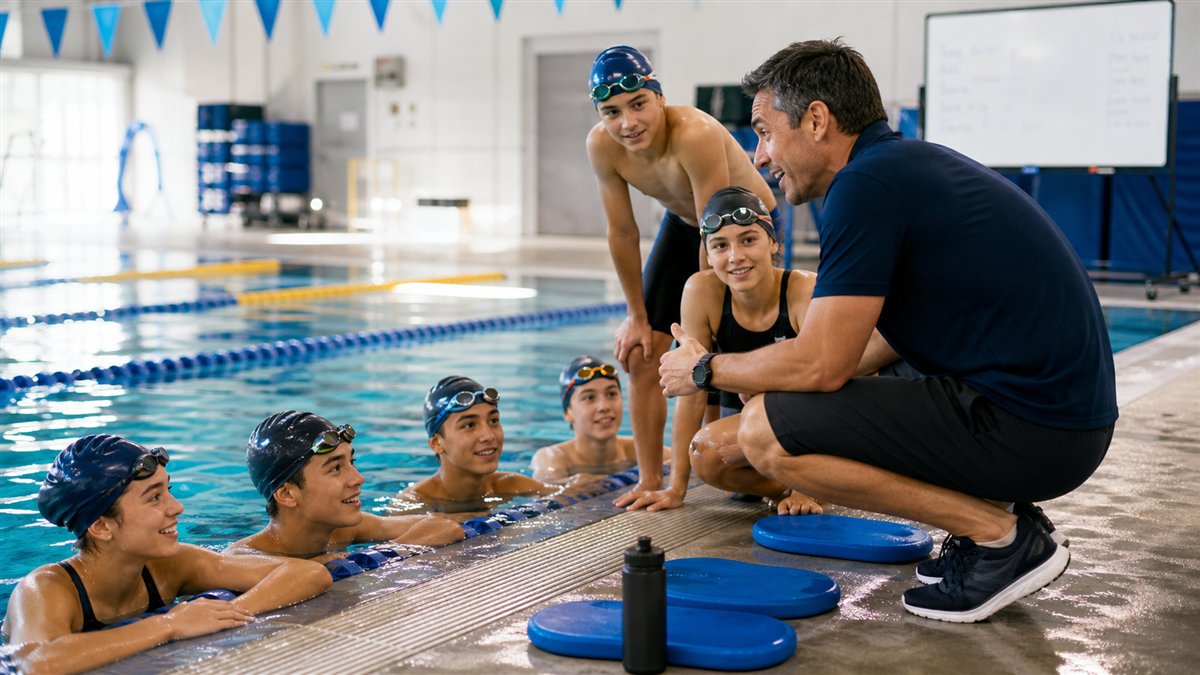
Quick summary
- Young swimmers who sprint the first length almost always fade badly by the last one.
- Pacing awareness is built through practice sets with target splits, not race-day instructions alone.
- Negative and even splits teach a swimmer to trust a plan instead of racing on adrenaline.
Why Young Swimmers Sprint the First Length
Definition
Pacing: Distributing effort evenly, or slightly increasing it, across a race instead of starting as fast as possible and slowing down as fatigue builds.
Adrenaline at the start of a race makes the first length feel easy, so a lot of young swimmers go out far faster than they can sustain. By the second half of the race, that early speed has already been spent.
This isn't a fitness problem most of the time. It's a pacing problem, and it's one coaches can address directly with practice, rather than telling a swimmer to just try harder at the end.
A swimmer who fades in the last length usually didn't lack fitness. They spent the fitness they had too early.
Even Splits and Negative Splits
Even splitting is usually the right starting point for younger swimmers, since it only asks them to hold a steady pace rather than manage a pace change mid-race. Negative splitting can come later, once even pacing feels natural.
Both approaches share the same underlying skill: knowing what pace feels like before the race starts, instead of finding out for the first time on the blocks.
Even splitting
Swimming each length or 50 in close to the same time, keeping effort steady from start to finish.
- Easier for younger or newer swimmers to learn first.
- Builds a reliable sense of sustainable race pace.
Negative splitting
Swimming the second half of a race faster than the first, which requires holding back slightly at the start.
- Better suited to more experienced swimmers.
- Teaches patience under the pressure of a fast field.
Practice Sets That Build Pacing Sense
Pacing has to be practiced with a clock, not just talked about. Sets built around target splits give a swimmer immediate feedback on whether they went out too fast.
These sets work best as a regular part of practice, not a one-time lesson before a big meet. Pacing sense fades quickly without repetition.
- Time a swimmer's best effort over the race distance to find a baseline pace per length.
- Break that pace into per-length targets and write them on a pace clock or whiteboard.
- Swim repeats at that target pace, checking splits after each one.
- Gradually adjust the target as the swimmer's pacing accuracy improves.
Carrying Pacing Sense to Race Day
On race day, the goal isn't a perfect split sheet, it's a swimmer who has a realistic sense of what pace feels like and can hold it under pressure. That sense only comes from having practiced it many times before.
Coaches can support this with a simple pre-race reminder tied to the practiced pace, rather than a new instruction introduced right before the race.
| Mistake | Why it happens | Practice fix |
|---|---|---|
| Sprinting the first 25 | Adrenaline, racing the swimmer next door | Pace-clock repeats at target split |
| Fading hard on the last length | Went out too fast to sustain | Negative split sets once even pacing is solid |
| Losing count of the pace mid-race | Pace was never practiced with a clock | Regular pace-check sets during practice |
Related SportX1 resources
Frequently asked questions
What age can young swimmers start learning pacing?
Most swimmers can start basic even-split work around age 9 or 10, once they can consistently swim the full race distance without stopping.
How often should pacing sets be part of practice?
Once or twice a week works well for most youth teams, with more frequent short pace checks added closer to a big meet.
Should coaches give splits during the race itself?
Calling splits can help, but the real goal is a swimmer who has practiced the pace enough to feel it without needing to hear numbers mid-race.
Build pacing work into every swim practice
Use SportX1 to plan pace-clock sets, track splits over time, and show swimmers their pacing progress.
Related articles
How to Teach a Wall Turn Young Swimmers Won't Slow Down For
A simple progression for teaching youth swimmers a clean, confident wall turn so races and practice sets don't lose momentum at every wall.
How to Teach a Relaxed, Efficient Freestyle Breath
A step-by-step approach for teaching young freestylers to rotate and exhale underwater so breathing stops breaking their stroke rhythm.
How to Help Young Swimmers Manage Pre-Race Nerves
A simple, repeatable pre-race routine covering warmup, breathing, and self-talk so nervous energy doesn't throw off a young swimmer's start or pacing.

About the author
SportX1 Editorial Team
Coach-reviewed guidance for youth sports learning, player development, team operations, and AI-supported coaching workflows.