

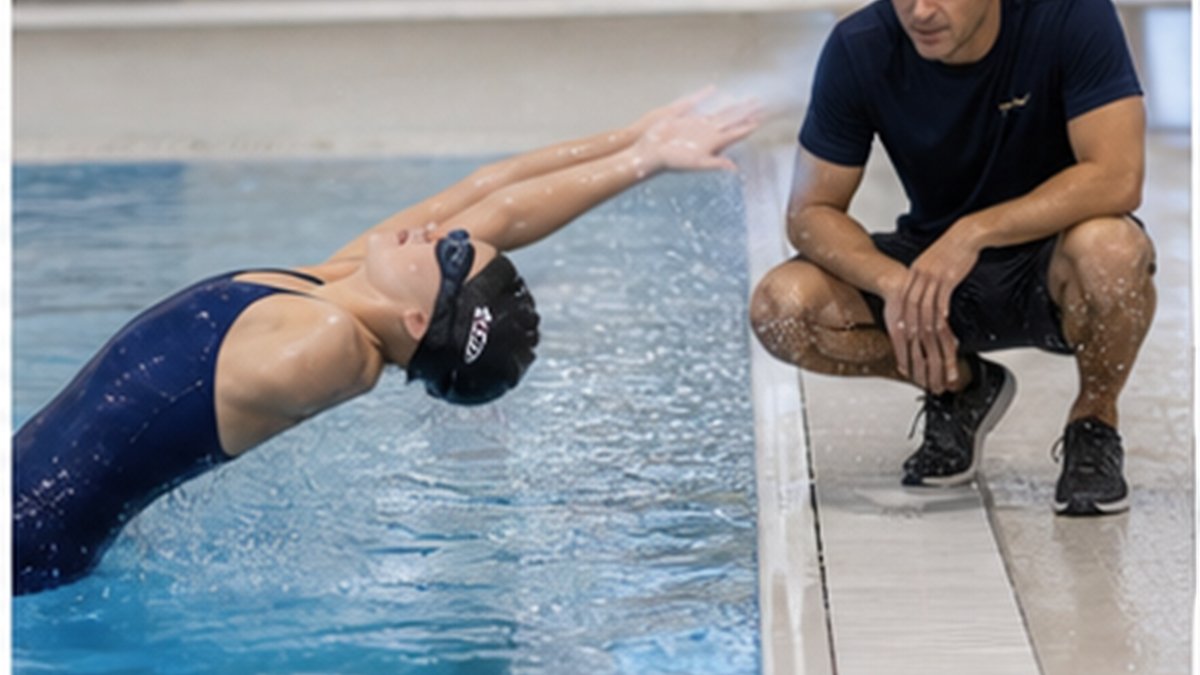
Quick summary
- A hesitant wall turn costs more time over a season than most stroke corrections do.
- Break the turn into approach, touch, and push-off, and drill each piece separately before combining them.
- Confidence at the wall usually comes from repetition at slow speed before it shows up at race speed.
A Slow Turn Costs More Than It Looks Like
Definition
Wall turn: The sequence of approaching the wall, touching or flipping, and pushing off that connects one length of a swim to the next.
It's easy to spend most of a practice on stroke technique and treat the wall turn as an afterthought. But a hesitant, slow turn adds up over a season of sets and races in a way that's easy to underestimate.
A confident turn also keeps a swimmer's rhythm intact, instead of resetting their pace every length.
Break the Turn Into Three Parts
Trying to fix an entire turn at once usually overwhelms a young swimmer. Breaking it into its three pieces makes each part easy to drill and easy to correct.
- Approach: judging the distance to the wall without looking up too early or too late.
- Touch or flip: a clean, quick touch or rotation without wasted movement.
- Push-off: a strong, streamlined push that carries speed into the next length.
| Part | What to watch for | Common issue |
|---|---|---|
| Approach | Judging distance without slowing early | Gliding in too soon and losing speed |
| Touch or flip | Quick, clean contact with the wall | A slow, hesitant touch |
| Push-off | Strong streamline off the wall | A weak push that loses momentum |
Drill the Turn Slow Before Adding Speed
Confidence at the wall builds from repetition, not from one big correction. Start with slow, deliberate reps where a swimmer can think through each part of the turn.
Once the sequence feels automatic at a slow pace, add it into regular sets so it holds up as fatigue and speed increase.
- Start turn drills at low intensity, separate from a full set.
- Add the turn into short sets before testing it in a longer, tiring set.
- Watch for the turn breaking down specifically when a swimmer gets tired.
A turn that only works when a swimmer is fresh and thinking about it isn't ready for a race yet.
Make Turn Work Part of Every Warmup
A few turn-focused lengths in warmup keep the skill sharp without needing a dedicated technique session every time. Consistency matters more than intensity here.
This also gives coaches an easy, low-pressure moment to spot when a swimmer's turn technique is starting to slip.
Related SportX1 resources
Frequently asked questions
What age should swimmers start working on turns?
Basic wall touches can start as soon as a swimmer is comfortable in the water, with flip turns usually introduced once freestyle and backstroke feel solid.
How much practice time should turns get?
A few minutes in most warmups, with occasional focused sessions, is usually enough to keep turns sharp.
Why does a swimmer's turn get worse during a race even if it's fine in practice?
Turns often break down under fatigue or excitement first. Practicing turns inside tiring sets, not just fresh, helps them hold up in a race.
Build turn work into every warmup
Use SportX1 to plan warmups, track turn technique progress, and keep pacing goals connected to practice.
Related articles
How to Track Swimming Player Development Without Extra Spreadsheets
How youth swimming coaches can track player growth, skill goals, feedback, and confidence without creating another spreadsheet routine.
How to Create a Youth Swimming Practice Plan Players Can Follow
A youth swimming practice-planning framework coaches can use to build clearer sessions, save time, and keep players connected to one learning goal.

How to Build a Pre-Shot Routine Young Golfers Will Actually Use
A simple, repeatable pre-shot routine junior golf coaches can teach so young players carry the same steps from the range to the course.

About the author
SportX1 Editorial Team
Coach-reviewed guidance for youth sports learning, player development, team operations, and AI-supported coaching workflows.