

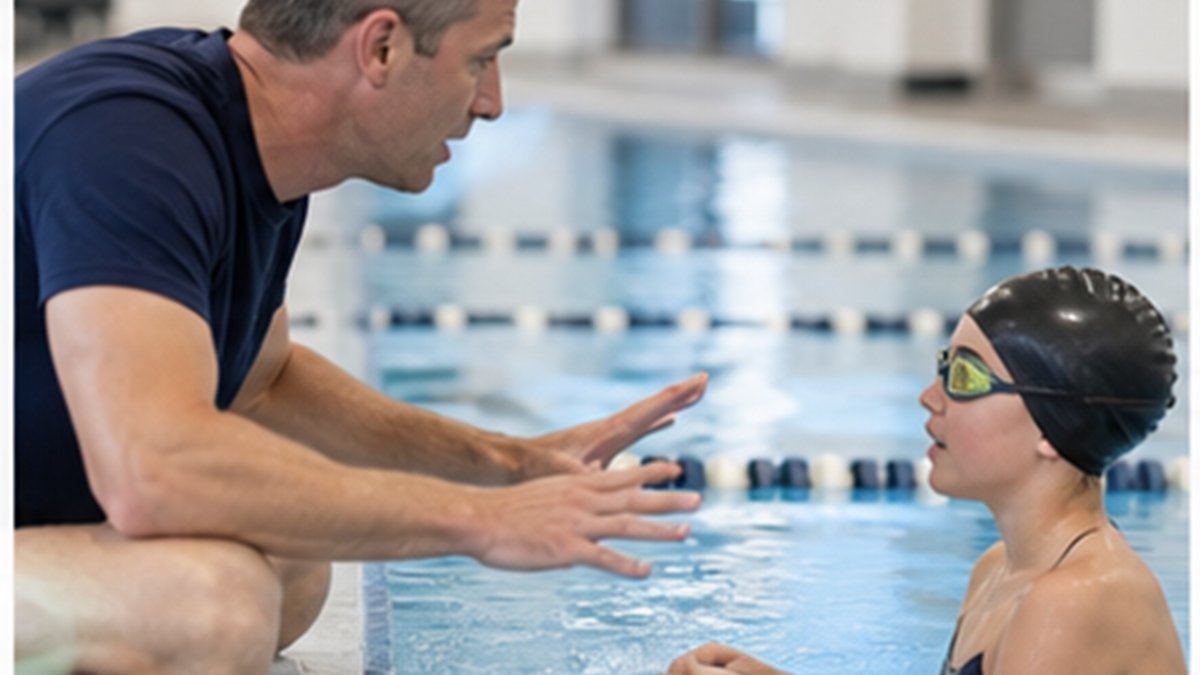
Quick summary
- Pre-race nerves are normal, but unmanaged anxiety often shows up as a rushed start or blown pacing.
- A short, repeatable pre-race routine gives a nervous swimmer something familiar to focus on.
- Breathing and simple self-talk cues work best when they're practiced in training, not introduced on race day.
Why Pre-Race Nerves Affect Performance
Definition
Pre-race routine: A short, consistent sequence a swimmer follows before every race, covering warmup, breathing, and a few self-talk cues, that gives nervous energy somewhere useful to go.
Some nervous energy before a race is normal, and even useful. Problems show up when that energy isn't managed and instead turns into a rushed dive, a start out of sync with the blocks, or a first length swum too fast just to get it over with.
Coaches can't remove nerves from a young swimmer entirely, and shouldn't try to. What helps is giving that energy a routine to move through instead of something to react to.
A swimmer doesn't need to feel calm to swim well. They need something familiar to do with the nervous energy.
Build a Simple, Repeatable Routine
The routine should be short enough to run through every single race, in practice meets and championship meets alike. If it only shows up at big events, it won't feel familiar when it's needed most.
Keep the steps the same regardless of how the last race went. A routine that changes after a bad swim isn't a routine, it's a reaction.
- Start warmup at the same point before every race, using the same strokes and distance.
- Add a short breathing sequence in the final minutes before the swimmer is called.
- Use one or two practiced self-talk cues right before stepping onto the blocks.
- Keep the same steps whether the last race went well or poorly.
Breathing and Self-Talk Cues That Work
Both breathing and self-talk work better as trained habits than as advice given moments before a race. A cue a swimmer has never used before rarely helps under pressure.
Coaches can build both into regular practice, using them before hard practice sets so they're already familiar by meet day.
Breathing
A few slow, controlled breaths in the last minute before a race can settle a racing heart rate without taking much time.
- Four counts in, four counts out, repeated four or five times.
- Practiced during regular training, not introduced cold on race day.
Self-talk
Short, specific cues work better than vague encouragement, since a nervous swimmer needs something concrete to focus on.
- A cue tied to the race plan, like 'strong first stroke off the wall.'
- Kept the same across races so it becomes familiar.
Practicing the Routine Before It's Needed
A pre-race routine is only reliable if it's been rehearsed enough times to run on its own, even when a swimmer is nervous. That rehearsal should happen in practice, well before a meet.
Coaches don't need a big production to build this in. Treating a few practice sets like a race, right down to the pre-set routine, is usually enough.
- Run the full routine before at least one hard set per week.
- Ask swimmers to name their self-talk cue out loud during a mock race.
- Debrief briefly after meets on what part of the routine helped most.
Related SportX1 resources
Frequently asked questions
Is it normal for young swimmers to feel nervous before every race?
Yes. Most swimmers feel some nerves before racing, and that's not a problem on its own. It becomes worth addressing when the nerves start affecting the start or pacing.
How long should a pre-race routine take?
A few minutes is usually enough, covering warmup completion, a short breathing sequence, and one or two self-talk cues right before the blocks.
What if a swimmer's nerves don't improve even with a routine?
Some swimmers need more time and repetition than others. If nerves are significantly affecting a swimmer's wellbeing beyond racing, it's worth involving a parent or, if needed, a sports psychologist.
Help every swimmer walk up to the blocks with a plan
Use SportX1 to share pre-race routines and track how swimmers are progressing on and off race day.
Related articles
How to Teach a Wall Turn Young Swimmers Won't Slow Down For
A simple progression for teaching youth swimmers a clean, confident wall turn so races and practice sets don't lose momentum at every wall.
How to Teach Young Swimmers to Pace a Race
Practice sets that build pacing awareness so young swimmers stop sprinting the first length and fading, and learn to hold or negative split instead.

Weekly Player Check-Ins That Build Confidence, Not Pressure
A short, repeatable check-in routine youth coaches can use to build player confidence through specific wins instead of generic encouragement.

About the author
SportX1 Editorial Team
Coach-reviewed guidance for youth sports learning, player development, team operations, and AI-supported coaching workflows.