

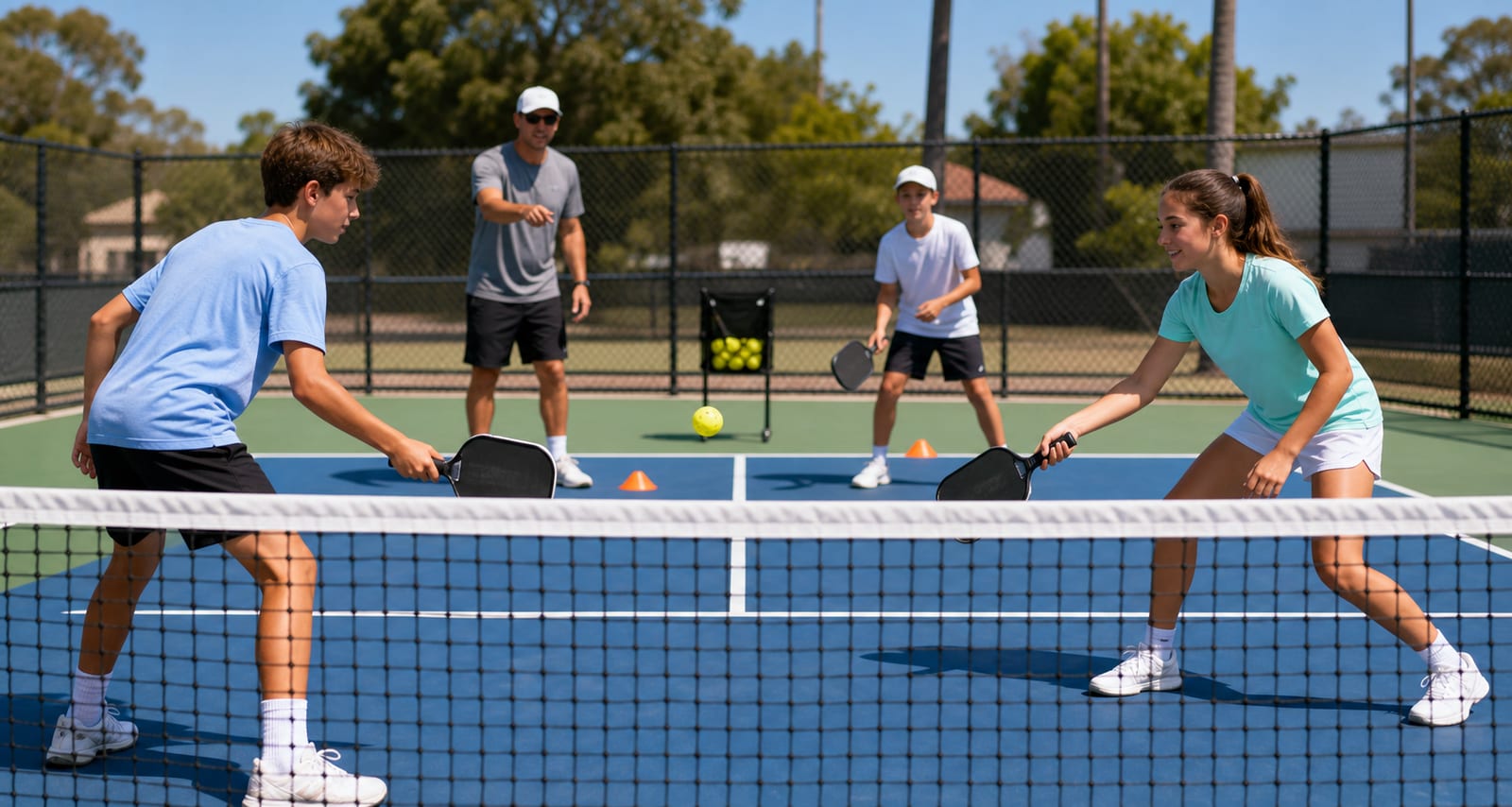
Quick summary
- A bad point or an unlucky net-cord shot can carry into the next point unless a player has a way to let it go.
- A short, physical reset habit between points works better for young players than trying to talk themselves calm.
- Coaches who reinforce the habit in practice, not just after matches, help it hold up under real pressure.
Why One Bad Point Can Derail a Whole Game
Definition
Reset routine: A short physical or mental cue a player repeats between points to let go of what just happened and refocus on the next one, regardless of whether the last point was won or lost.
A single unlucky net-cord shot or a missed easy put-away can stick with a young player for several points afterward, even if they don't say anything about it. That carried frustration often shows up as tighter shots and rushed decisions on the very next point.
Without a way to let go of what just happened, one bad point can turn into three or four, and the score starts to reflect the player's mood rather than their actual game.
- A player slumps their shoulders or drops their paddle after a lost point and carries that posture into the next one.
- Serves and returns get rushed right after a mistake, without resetting first.
- A player starts blaming a bad bounce or a partner instead of moving on to the next point.
A Physical and Verbal Reset Habit
Young players usually respond better to a small physical action than to being told to "calm down" or "forget about it." A simple, repeatable motion gives them something concrete to do instead of just a feeling to manage.
Pairing that motion with a short phrase reinforces it further, especially for players who process things verbally.
A physical reset
A paddle tap on the ground, turning to face the back fence for a second, or one slow breath before walking back to the line all work as a small, repeatable action between points.
A verbal reset
A short phrase like "next point" or "reset," said quietly or even just to themselves, gives a player a mental cue that pairs with the physical action.
Building the Habit in Practice, Not Just in Matches
A reset habit that only gets introduced during a tough match will feel unfamiliar exactly when a player needs it most. It has to be practiced during regular drills, where the stakes are lower, so it becomes automatic.
Coaches can build this in without slowing down practice much, by simply expecting the habit after every point, good or bad.
- Pick one physical cue and one short phrase, and introduce both during a low-pressure drill.
- Require the reset after every point in practice games, not only after mistakes.
- Point out when a player skips the reset after a bad point, and have them go back and do it.
- Reinforce the same habit during scrimmages and matches so it carries over.
Reading the Moment a Player Needs It Most
Some situations call for the reset habit more urgently than others, and coaches can help by naming those moments out loud in the beginning. Over time, the player starts recognizing them without a reminder.
This is also where coaching for composure ties back to keeping players engaged in the sport long-term. A player who has a way to handle a bad point is less likely to get discouraged and check out.
| Situation | What to Reinforce |
|---|---|
| An unlucky net-cord shot goes the opponent's way | The bounce was out of anyone's control; reset and move on |
| A missed easy put-away | One point does not decide the game; go straight to the reset habit |
| A string of lost points in a row | Slow down between points and lean on the routine more, not less |
Related SportX1 resources
Frequently asked questions
What age should coaches start teaching a reset habit?
Most players can start around age 8 or 9, once they're old enough to notice their own frustration and follow a simple, repeatable routine.
Should the reset habit be different after a good point versus a bad one?
No, using the same habit after every point, regardless of outcome, is what makes it feel automatic rather than like damage control.
How do I know if a player is struggling with composure, not just skill?
Watch for rushed serves or returns right after a mistake and body language that carries from one point into the next; those are signs the issue is emotional, not technical.
Support players through the tough moments, not just the skills
Use SportX1 to track composure and development goals, and keep coaches and parents aligned on how a player is handling pressure.
Related articles
How to Teach Young Players to Win the Kitchen Line With Dinks
A coach-friendly progression for teaching youth pickleball players soft-game control at the kitchen line, instead of relying on power shots alone.
How to Teach Young Doubles Teams to Move Together at the Net
Drills and coaching cues that teach young pickleball doubles teams to move as a connected unit at the kitchen line instead of playing two separate singles games.
How to Track Pickleball Player Development Without Extra Spreadsheets
How youth pickleball coaches can track player growth, skill goals, feedback, and confidence without creating another spreadsheet routine.
About the author
SportX1 Editorial Team
Coach-reviewed guidance for youth sports learning, player development, team operations, and AI-supported coaching workflows.