

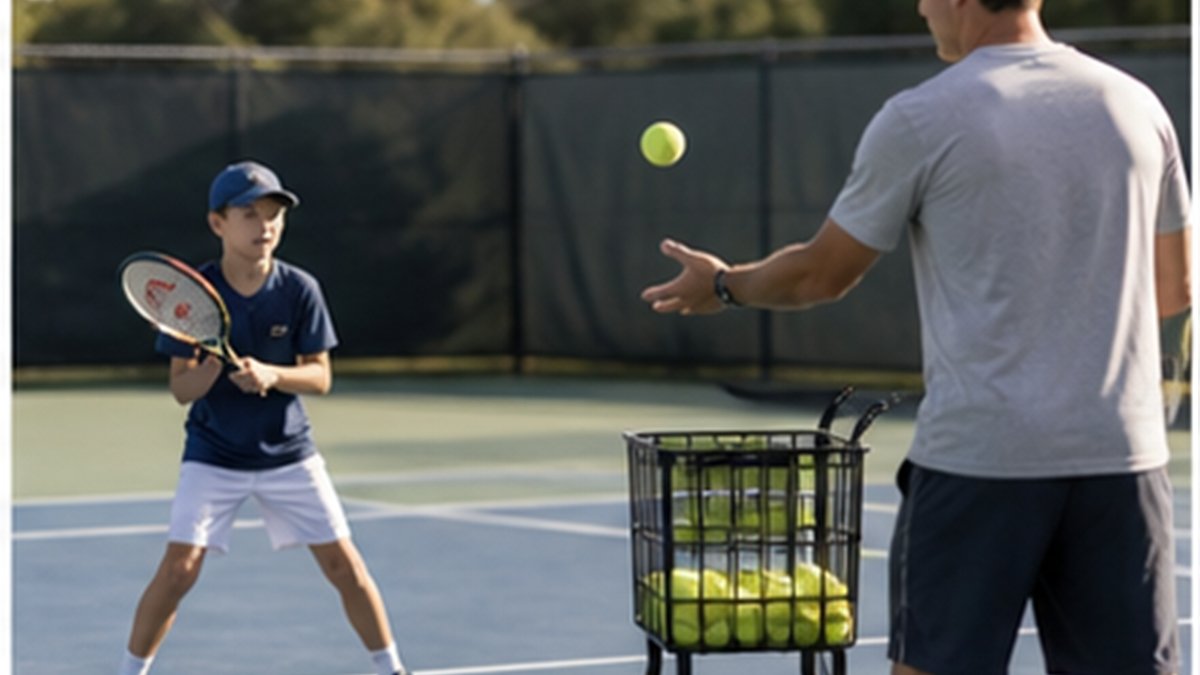
Quick summary
- Tennis-specific movement, like split-step timing and recovery steps, breaks down before general fitness does.
- Movement endurance drills should mimic real point patterns using the court's actual dimensions.
- The useful signal to train is when footwork quality drops, not simply when a player feels tired.
What Movement Endurance Actually Trains
Definition
Movement endurance: The ability to sustain efficient footwork, court coverage, and recovery to a ready position across a long match, as distinct from general cardiovascular fitness.
A young player can be fit and still fall apart on court late in a match, because tennis-specific movement breaks down before general fitness does. Split-step timing slows, recovery steps shorten, and shot preparation gets rushed.
Movement endurance training targets that specific breakdown. It's less about running a player into the ground and more about training their footwork to hold up under repeated, tennis-specific movement patterns.
A tired player who still moves well will usually outlast a fitter player whose footwork falls apart under fatigue.
Train Movement in Patterns That Match Real Points
Generic conditioning, like distance running, doesn't transfer well to tennis movement. Points involve short bursts, direction changes, and a recovery step back to a ready position, over and over.
Movement endurance drills should mimic that pattern directly, using the court's actual dimensions rather than open space.
- Set up a live-ball rally drill with a defined shot count per point.
- Require a full recovery step back toward center after every shot.
- Increase the shot count per point gradually as the player's movement holds up.
- Rest between points to match realistic match pacing, not continuous running.
Watch for When Footwork Breaks Down, Not Just When a Player Gets Tired
The useful signal in movement endurance training isn't fatigue itself, it's the point at which footwork quality drops. That's the threshold worth training just past, not blowing far beyond.
Coaches can use simple markers to know when a session has done its job without pushing a young player into pure exhaustion.
| Stage | What to Watch For | Coaching Response |
|---|---|---|
| Early fatigue | Slightly later split-step timing | Continue the drill, note the marker |
| Moderate fatigue | Shortened recovery steps back to center | Add a short rest, then resume |
| Overreach | Rushed shot preparation, poor balance | End the movement block for the day |
Avoid Overtraining a Skill That's Still Developing
Young players are still developing coordination, and pushing movement volume too far too fast raises injury risk without adding much benefit. More reps only help up to the point where form holds.
Shorter, more frequent movement blocks across the week tend to build endurance more reliably than one long, exhausting session.
- Cap movement-focused blocks at 15 to 20 minutes for younger players.
- Prioritize recovery days between high-intensity movement sessions.
- End a drill once footwork quality drops, not once the player asks to stop.
- Build movement work into regular practice rather than treating it as separate conditioning.
Related SportX1 resources
Frequently asked questions
How young is too young for dedicated movement endurance work?
Most coaches introduce structured movement drills once players are consistently rallying, often around age 9 to 11, keeping sessions short and playful before that.
How often should movement endurance drills happen each week?
Two to three shorter sessions built into regular practice tend to work better than one long conditioning day, especially for younger players.
Is this the same as general fitness training?
No. General fitness supports overall conditioning, but movement endurance specifically trains tennis footwork patterns like recovery steps and split-step timing under fatigue.
Plan movement work that fits inside real practice
Use SportX1 to build short, tennis-specific movement blocks into weekly plans and track footwork quality over time.
Related articles
How to Teach the Split-Step So It Actually Becomes a Habit
A simple progression for teaching young tennis players the split-step, so recovery footwork becomes automatic instead of something they only do when reminded.
How to Teach Young Tennis Players a Simple Reset Between Points
A short, repeatable mental reset routine coaches can teach so a young player's bad point doesn't turn into a lost game.
Best App for Youth Tennis Coaches: What to Look For
A practical guide to choosing a youth tennis coaching app for practice planning, player development, AI support, and team communication.

About the author
SportX1 Editorial Team
Coach-reviewed guidance for youth sports learning, player development, team operations, and AI-supported coaching workflows.